Care teams have enough on their plates. Ordis was built to give some of that time back. We ease the burden and improve efficiencies in long-term care documentation using speech-to-text technology. In this blog, we share our learnings, what we have developed in response to our customers’ needs, and the progress we have made with our technology.
Authors & Contributors: Sandeep Kannirasan, Alex Gibson, Dr Zara Quail, John Dabill, Ioana Maria Constantin, Elaine Molony
At Ordis, we first started assessing the care and documentation requirements in long-term care environments and the potential for artificial intelligence voice infrastructure to support these processes. We observed nurses and care assistants spending a significant part of their shift manually entering essential information into different systems about the people in their care, including progress notes, incident reports and healthcare record updates. Our initial pilots demonstrated how use of the Ordis platform has helped to streamline the notes capture process through speech-to-text technology, enabling care providers to do what they first set out to do, providing care and quality time to those in their care.
While it has been worthwhile seeing the benefits our speech-to-text technology has had in the direct care environment, we have also seen the advantage it offers in wider aspects of management. In specifically listening to our customers’ needs, we have expanded the utility of our system from incident reporting to the use for progress notes, the documentation task that staff consistently identify as the most time-consuming part of their day.
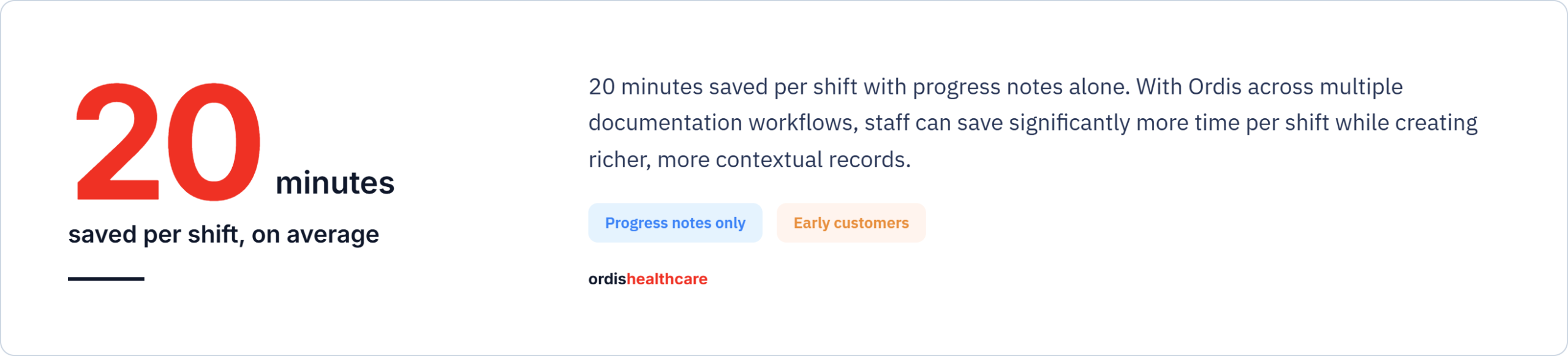
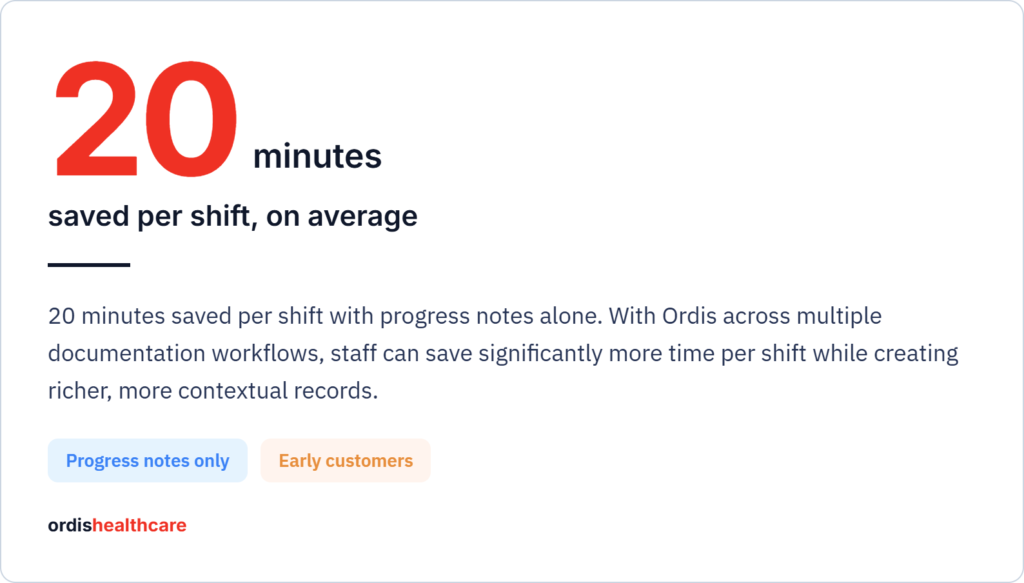
Through our initial user feedback, early nursing home pilots gave us the first real evidence of impact. Even without integration into a facility's existing systems, care staff saved an average of 20 minutes a shift using the Ordis platform for documentation. Even 20 minutes of time back in a shift of a care provider can allow much needed time for e.g., less time-pressured chats with people in their care or even a short break or. While providing safe and accurate care documentation is a primary goal, a secondary benefit is the potential improvement of the workflow processes for employee satisfaction and workforce retention.
In consistently observing the needs of our customers, the Ordis platform has undergone several developments, including refinement of accent accuracy in the voice capture and the development of customisable forms.
Care is delivered by people from all over the world, and off-the-shelf voice technology often lets them down - struggling with accents, local names and unfamiliar medications. We didn't think that was good enough.
At Ordis, we have continued to invest specifically in accent training, using machine learning to improve recognition across the range of accents in the nursing home workforce, rather than assuming a single “standard” voice. Getting speech-to-text interpretation right is essential, in a clinical documentation context, a misheard word is a safety issue. We have been intensively training our models to be able to reliably capture the speech of every member of staff, now a core feature of our system, especially accents from South Asia who make up a large proportion of the long-term care workforce in Ireland and the United Kingdom.
In refining our speech-to-text technology, we have our own machine learning pipeline that has different stages, each with a different logic specific to the care environment. This is all about speaking your home’s language and creating forms that match how you already work.
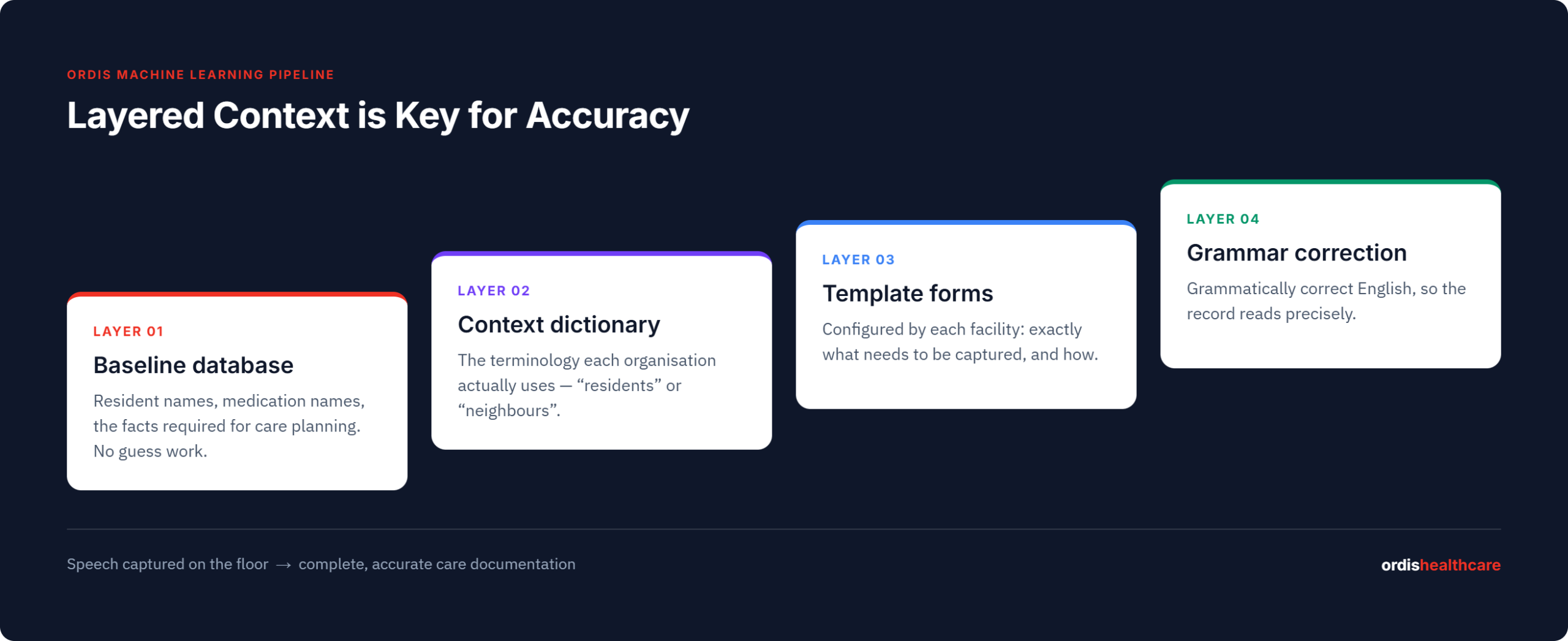
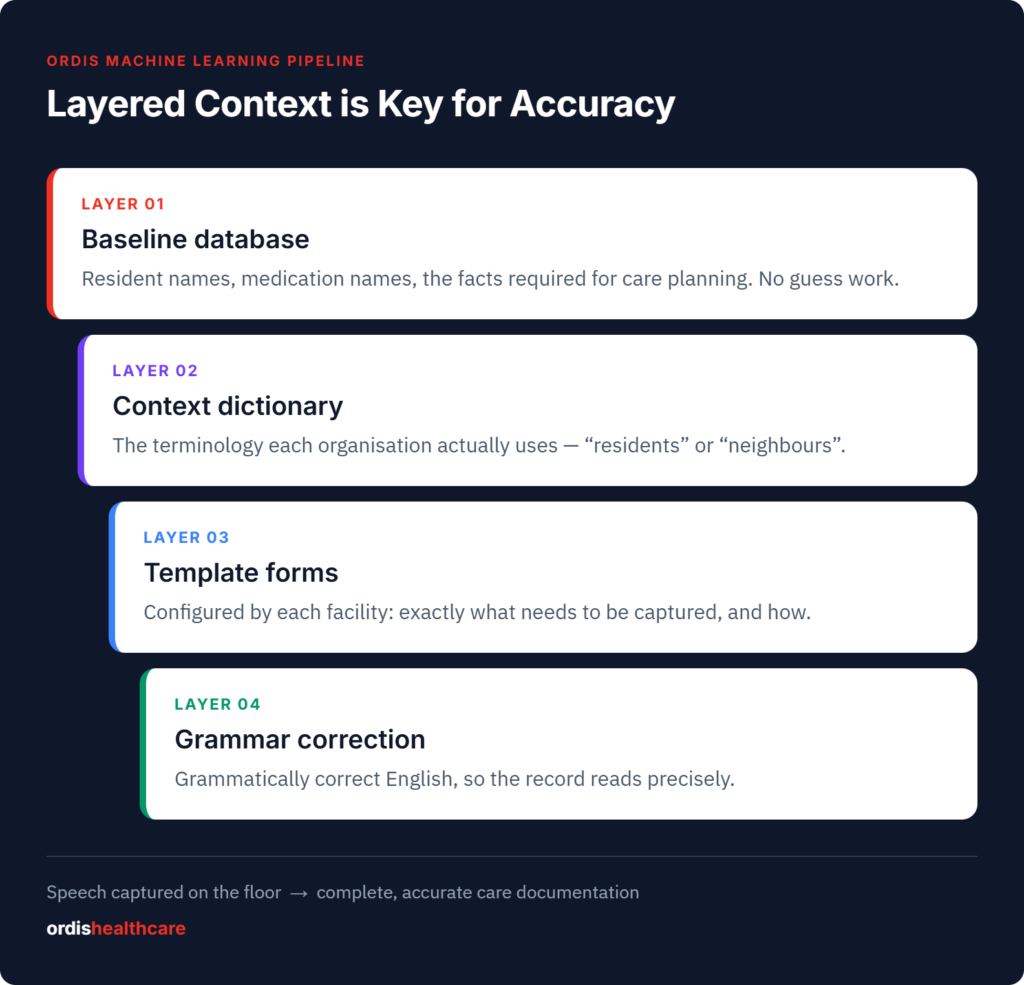
The first layer of our system enables the understanding of key factual information, for example, Irish names (like Owen or Eoin) or medication names. We don’t allow any guess work in our system. We have built a baseline database with facts required for care planning based on the essential data defined in collaboration with care management software requirements.
A context dictionary is the next part of the machine learning layer. Context needs to be specific to an individual care receiver, their environment, the care provider, the facility requirements and group requirements in the case of long-term care group nursing homes. Language in care is not neutral. One facility might refer to the people it supports as “residents,” another, offering independent and assisted living, may prefer “neighbours.” Clinical terminology also varies, for example, institutional preferences around terms used for various activities of daily living. A context dictionary has been developed to support different organisations with their specific language use. Starting with standard nursing home and care terminology, the context dictionary can be extended and adjusted to match each organisation’s own terminology use. This is what allows the system to sound less like generic software and more like it understands the specific care home context in which it functions.
The next layer is the template forms. Each organisation and their facilities have different requirements when it comes to data capture. As every care setting is different, the information that needs to be captured varies by organisation, service type, and even by team. Ordis healthcare has now developed templates that can be customised by each customer, building notes and forms to their own local needs. In addition, the Ordis system has been developed with instructions that will place all the captured information within the customisable templates. Rather than forcing a fixed structure, we have developed a template builder that lets facilities configure exactly what needs to be captured, and how, adapting the system to their environment rather than having to adjust their workflow to a new system.
The final layer of the tiered system is grammar correction. As accurate documentation relies on readability and precise word use, the current use case for English-speaking regions ensures that the information output is in grammatically correct English.
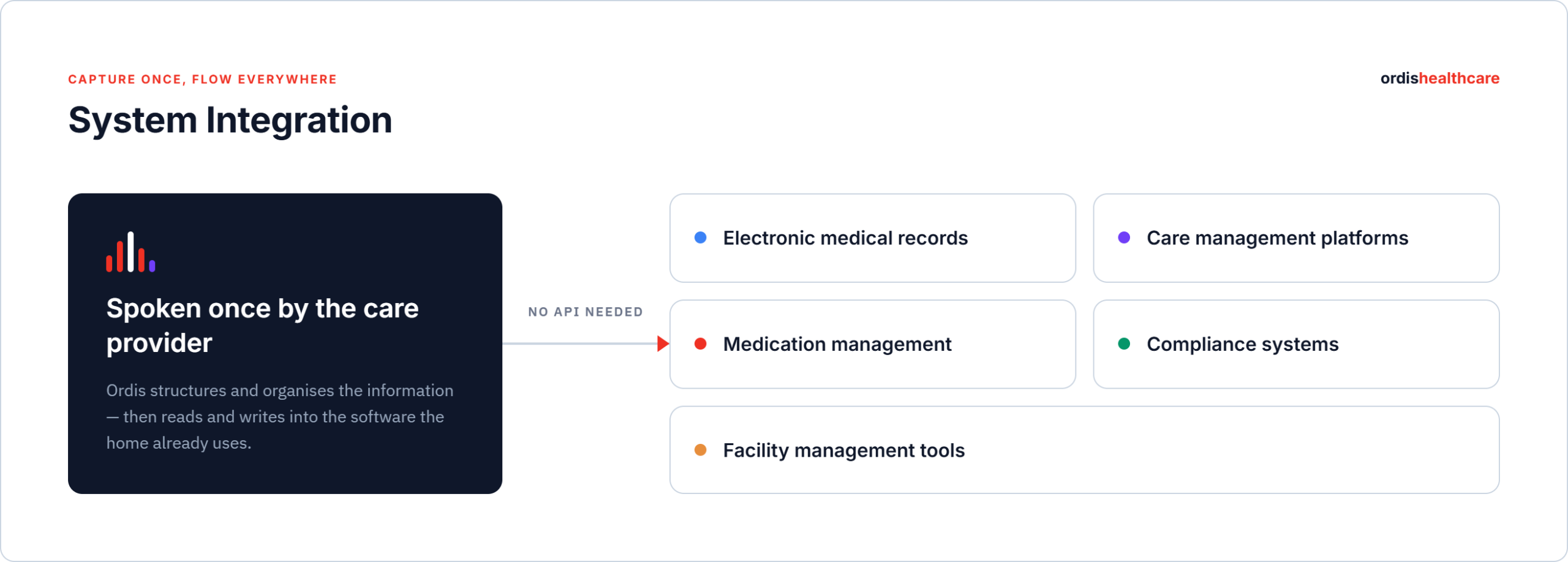
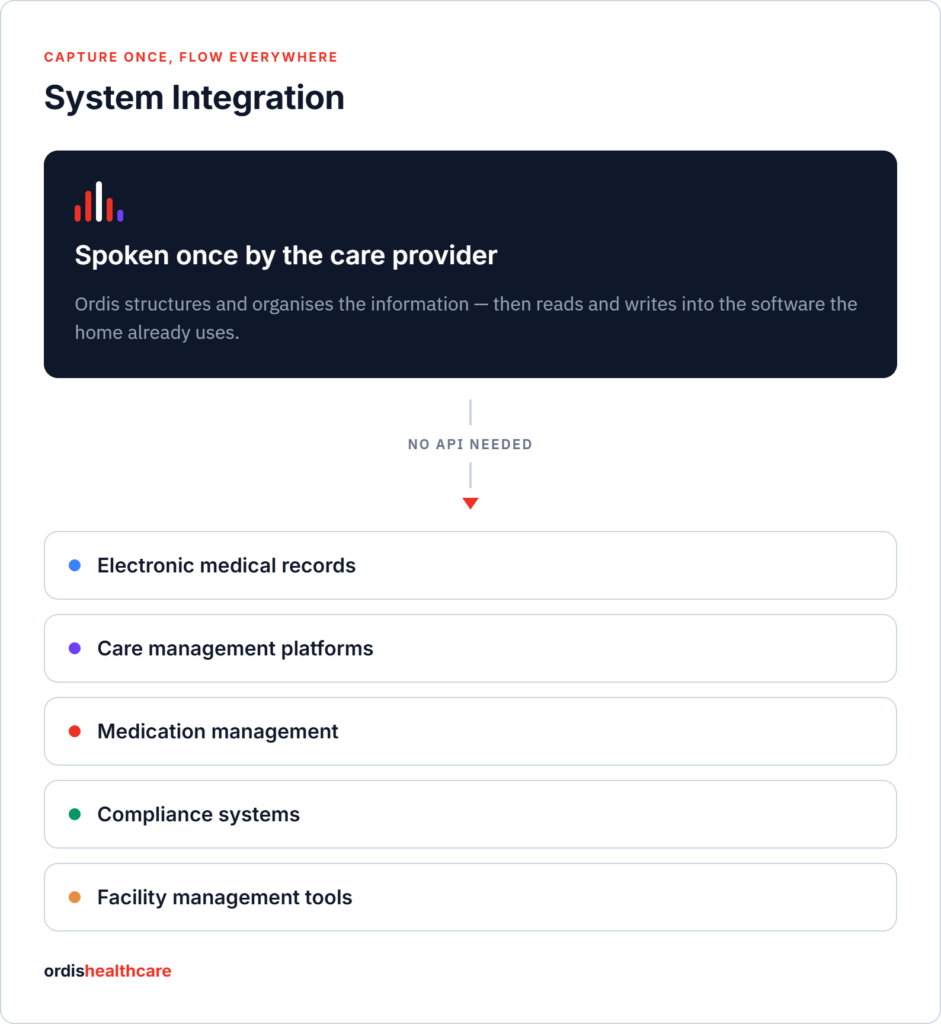
Nursing homes typically run several systems in parallel: electronic medical records, care management platforms, medication management software, compliance systems, and increasingly, facility management tools. Our recently developed feature enables interoperability via automation with existing care management software. This means that the Ordis system does not need the care management software company to share an application programming interface (API) for integration. Ordis can read and write into any software the nursing home is using. As our development work progresses, we have seen Ordis advance from a helpful tool to genuinely enhancing a care provider’s workflow when information only needs to be captured once and can then flow to where it is needed in different systems.
In our interactions with long-term care management and providers, trust is the most common barrier we encounter, and rightly so. Care providers are understandably cautious about compliance concerns and quality assurance when adopting new technology, and we have built our approach around addressing that directly in the platform build.
Ordis trains and hosts its own model, in our own secure environment. Ordis is GDPR compliant. No data is sent to third-party foundational models. This approach has clear benefits. For customers, it means stronger data privacy, since data is never shared outside our own secure environment.
We know how important clinically accurate documentation is to support safe, continued care. We have designed the Ordis platform to specifically refer to a context dictionary, so the system knows what is expected in terms of output for specific situations and environments.
On the regulatory side, we are progressing towards registering the Ordis Healthcare platform as a Class 1 medical device and have engaged specific regulatory support with this goal in mind. We have a dedicated Data Protection Officer overseeing our approach to GDPR, data sharing, and the requirements of the EU AI Act. This is not treated as a compliance checkbox; it shapes how the platform is designed from the start.
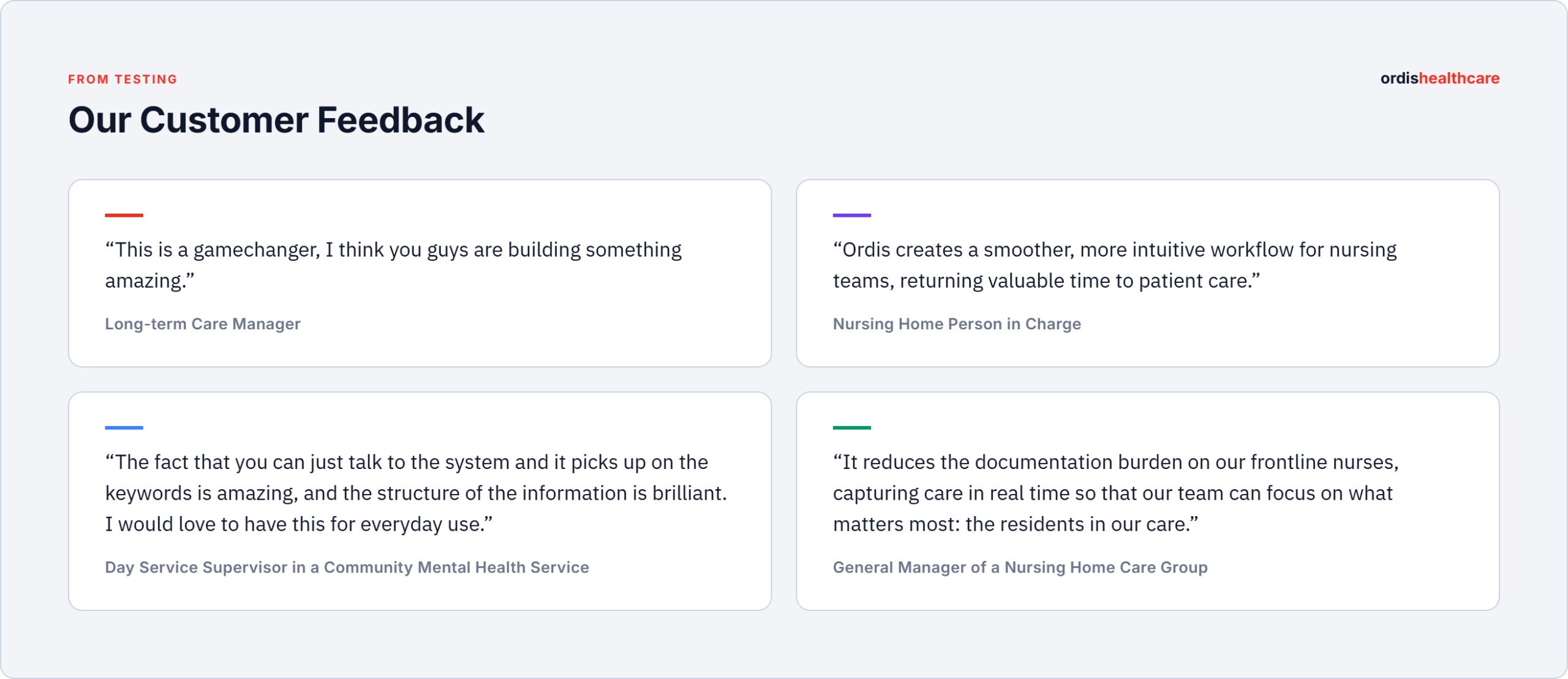
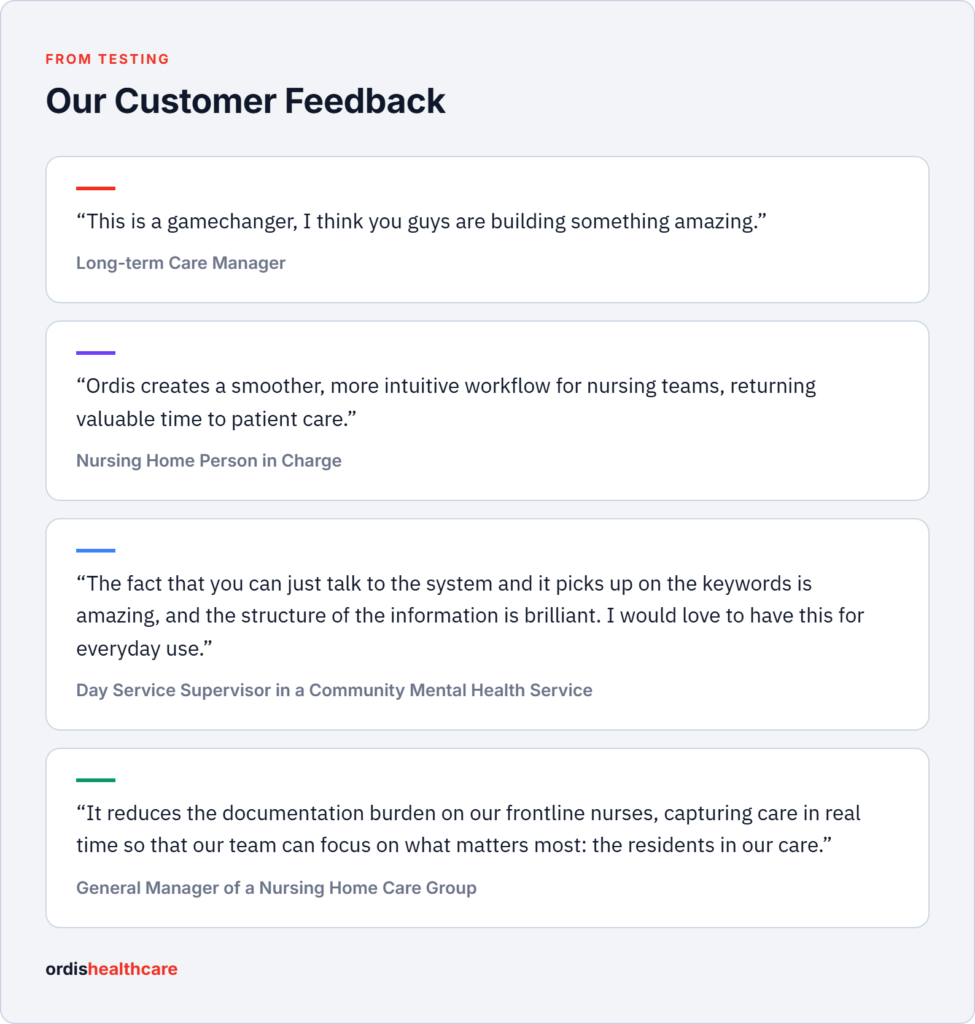
During testing, feedback from customers has both informed our development and encouraged our progress. While we document the specific needs and findings of our customers, their general commentary has also been enlightening for the Ordis Team.
It is worth being clear about what the Ordis Healthcare technology is, and what it is not. Ambient AI scribes used in hospital and primary care settings are typically built around long, structured, time-constricted clinical consultations. Long-term care is different: information arrives in short, fragmented interactions, from multiple care providers, throughout the day, and needs to be gathered and pieced together over time.
Ordis has been designed from the outset for this environment. It involves less direct interaction than a typical clinical scribe, because it is built to support workforce management and quality of care in a long-term residential care setting over time, not to transcribe a single consultation. We see this as a distinct category for Ordis as a product: infrastructure for consistent, quality long-term care documentation, built around how long-term care homes actually work.
At Ordis Healthcare, we have developed a layered system that considers baseline facts as the foundational layer, then builds on the data with further contextual considerations for care through the context dictionary along with accurate accent interpretation and grammar refinement to provide a robust pathway to create complete and accurate long-term care documentation.
Ordis Healthcare has rapidly evolved, through needs-based customer assessment, from a tool that captures information accurately, to a platform that helps care homes to document numerous aspects of the direct care and facility requirements using accent-trained, speech-to-text technology along with contextual guidance and customizable forms.
In clearly identifying the needs of our customers and their staff, in 8 months, we have moved the Ordis Healthcare system from a validated concept to a platform long-term care homes are choosing to invest in.
As a voice-first documentation platform, Ordis enables staff to speak in their own words, while the platform structures and organises that information for your existing care management software. If you would like to see how Ordis could work in your organisation, we would be glad to talk.
Contact Team Ordis at info@ordishealthcare.com
X
A relaxed 20-minute session away from the event floor.
your first year when you book a demo at the Care Show.
Hear how customers eased the reporting burden whilst staying compliant, plus a live demo and Q&A.
A 3-minute walk from the floor, in an NEC meeting room, with nibbles.
Get staff off manual reporting and back to frontline care, and improve retention.